Each year, we release this agenda to ensure that legislators are chiefly aware of how their proposed legislation impacts African Americans and other underserved communities within Louisiana. A few weeks ago we wrapped up a Statewide Listen & Learn Tour with the Louisiana Legislative Black Caucus sponsored by Southern Poverty Law Center. This tour took us to 7 cities across our state, and is one of the most important ways we are informed on policy changes needed.
Take a quick moment to read through the 49 bills we support and the 14 we oppose. Then share this report with others you know.
It is with your interest in mind that we are supporting legislation such as HB 374 and SB 149, that seek to increase the state minimum wage, as well as HB 318, that aims to make our communities safer by prohibiting the manufacturing and possession of machines guns responsible for too many deaths in all communities of our state and country. Likewise, we oppose SB46 because it improperly empowers elected officials, outside of education, to regulate the materials taught in our schools. We firmly believe that education decisions impacting our students should be reserved for educational leaders and practitioners who serve our children and families. We cannot afford to politicize our children’s education when we face so many challenges to improve outcomes and close education equity gaps.
Visit https://urbanleaguela.org/2023agenda/ today to track each bill and learn now you can advocate and help advance these important causes.
]]>
Graphics & Sample Social Media Captions
- It’s time to #WakeUpGeauxVote! Show up and make your voice heard on March 25.
- Do you know where you’re voting? Find out your polling location at GeauxVote.com. #WakeUpGeauxVote
- It’s almost election day, so it’s time to make your plan now. Make sure you are registered for the upcoming election at GeauxVote.com. #WakeUpGeauxVote
- Black voters can strengthen Louisiana. Make your voice heard and #WakeUpGeauxVote on March 25.
- Don’t forget to tag Urban League of Louisiana when you post! @UrbanLeagueLA
Issued: June 9, 2022
Today – The President and CEO of the Urban League of Louisiana, Judy Reese Morse issued the following statement:
“There is a long history of discriminatory actions, policies and practices by law enforcement in this state, including the case of Ronald Greene, who was killed at the hands of Louisiana State Police on May 10, 2019. We applaud Assistant US Attorney General Kristen Clarke and the US Department of Justice Civil Rights Division for today’s announcement that it is opening a civil pattern or practice investigation into Louisiana State Police which we first requested on May 25, 2021 along with National Urban League President and CEO, Marc H. Morial. While we understand the criminal investigation into the death of Mr. Greene is ongoing, we view this larger federal investigation into the Louisiana State Police as an important and monumental first step towards increasing transparency, accountability and delivering needed reforms. The Urban League of Louisiana has provided strong advocacy on this issue including the organization creating a petition that secured over 27,000 signatures, led a coalition of civil rights and community organizations in a press conference to amplify this issue, sent letters to federal and state officials requesting action, and provided weekly updates to our advocacy network and the public. The Urban League of Louisiana remains committed to providing critical advocacy for African American and other marginalized communities in their pursuit for civil rights, equity and economic self-reliance.”
Anyone with information pertinent to the United States Department of Justice’s investigation is encouraged to reach out to:
Email: Community.Louisiana@usdoj.gov
Toll-free phone: (202) 353-0684
The Urban League of Louisiana recently released the second edition of Advancing Educational Equity In New Orleans Public Schools which tracks inequities and illustrates the urgent need for racial equity in schools. While many stakeholders have a part to play, the Orleans Parish School Board is critical to advancing racial equity within our education system.
The forums October 6 – October 8 from 5-7pm will allow citizens to hear directly from candidates about their position on racial equity and their plans for addressing specific inequities documented in the Urban League’s report, if elected to serve.
Tuesday, October 6th – Districts 1 & 2
Moderator: Will Sutton, Staff Columnist, The New Orleans Advocate
Confirmed candidates:
- John A. Brown Sr., District 1
- Patrice Sentino, District 1
- Asya M Howelette, District 2
- Aldine “Doc” Lockett, District 2
- Chanel M. Payne, District 2
Wednesday, October 7th – Districts 3, 4, 5
Moderator: LeBron Joseph, Anchor/Reporter, WGNO TV/WNOL-TV NOLA38
Confirmed candidates:
- Philip C. “Phil” Brickman, District 3
- Olin Parker, District 3
- Jancarlo “J.C.” Romero, District 4
- Winston “Boom” Whitten Jr, District 4
- Katherine Baudouin, District 5
- Grisela Jackson, District 5
- Antoinette Williams, District 5
Thursday, October 8th – Districts 6 & 7
Moderator: Oliver Thomas, Radio Talk Show Host, WBOK
Confirmed candidates:
- David Alvarez, District 6
- Erica Martinez, District 6
- Carlos L. Zervigon, District 6
- Jamar Wilson, District 7
- Nolan Marshall Jr., District 7
On October 15, from 5-7pm, ULLA will host a lively conversation featuring experts from across the state who will be discussing key races statewide, the seven statewide amendments, and will look at the responsibilities of different elected positions.
To register for these forums, visit our Wake Up Geaux Vote page.
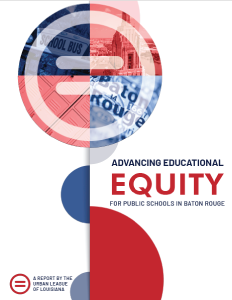
]]>This recent analysis builds on our 2017 report and captures changes since the 2016-2017 school year in the areas of academic outcomes, school climate and access. The findings show disparities across race, ethnicity, and socioeconomic status begin early and last throughout a student’s academic career:
- In 3rd grade, economically disadvantaged and African American students are less likely to read at grade level;
- Economically disadvantaged and African American students continue to be underrepresented in high-quality schools and in college-level courses;
- Performance of economically disadvantaged students and African American students continues to lag behind their peers in high school End-of-Course exams and ACT; and
- While graduation rates for economically disadvantaged students and African American students have increased since 2017, gaps continue to exist – economically disadvantaged students and African American students are more likely to attend a high school where fewer students graduate on time, earn additional academic or career credentials, and enroll in college after graduation.
While the findings of this report are surprising to many, they are a renewed call to action. Although how we educate is different due to the pandemic, we must still center equity so that our response to COVID-19 does not further the inequities that already existed.*
We look forward to working in partnership with a wide range of multi-sector stakeholders especially parents, families, teachers, school board members, and school district leadership, to put the data to use, examine policies and structures, and increase transparency and accountability for changing them.
Our community cannot afford to ignore the disparities our children are experiencing, and we must all play a part in advocating for transformation that truly serves all students.
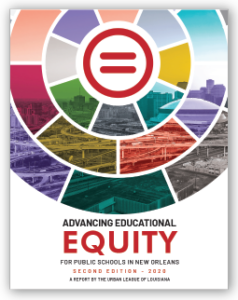
CLICK THE COVER TO READ THE REPORT.
In case you missed it, read our other Education Equity reports here.
]]>Public schools in Louisiana and across the country are facing significant challenges resulting from the pandemic which has made inequities present in our state increasingly visible; inequities that include limited access to food, physical and mental health care, transportation, technology, housing, and more – all of which significantly impact a student’s opportunity to learn. School closures due to COVID-19 have placed a spotlight on the impact of these inequities and it is vital that schools and districts, as they are preparing for the fall and beyond, keep educational equity central so that our response to these unprecedented circumstances does not compound disparities that already existed for economically disadvantaged students and students of color.
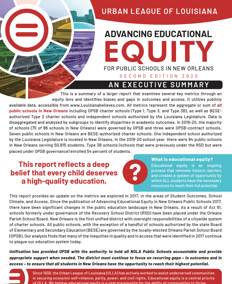
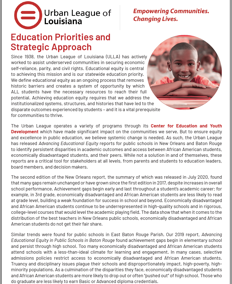
For that purpose, the Urban League of Louisiana is sharing a framework for statewide education equity. This framework outlines the Urban League’s commitment to see equity infrastructure built into our education systems moving forward so that all students and families have the resources and support to succeed in school and in life. Read our strategic approach.
]]>The Urban League of Louisiana wholeheartedly supports House Resolution 13 presented by Representative Ted James earlier today that “establishes a study group to study law enforcement systems and policing.” This is a tremendous step forward for Louisiana in the continuing struggle to eradicate systemic racism within law enforcement.
We understand that words matter. We understand that tone matters. But we also know that in order for an issue to be solved, it has to be faced.
The act of demanding the removal of Mr. George Floyd’s name because it makes some lawmakers uncomfortable reveals the need for this conversation to continue among those in positions of power and influence. In order to create sustainable change for racial equity, policy decision makers cannot ignore the racial disparities in law enforcement or the nation’s long history of racism.
In order for these efforts to be successful, we must face our past and look deeply into the systems that have long divided us, even if it makes us uncomfortable. This is the work that we must do together as a nation.
In the immortal words of author and activist James Baldwin, “Not everything that is faced can be changed, but nothing can be changed until it is faced.”
Read about one of our recent strategies in the latest newsletter from the U.S. Census Bureau Atlanta Region for the state of Louisiana and earlier efforts featured in the Census Bureau’s Regional Complete Count Journal .
Join us in making sure everyone in Louisiana is counted – our communities depend on it!
]]>As most disasters have in the past, the COVID-19 pandemic has magnified generational inequities and disparities that have left poor, working class and African-American communities suffering disproportionately in ways that include, but reach far wider than, what the COVID-19 infection and death data shows. According to PolicyLink, data shows that more than 100 million people in the U.S., most of whom are people of color, have struggled to make ends meet even before this pandemic. National Urban League President and CEO Marc Morial said “the virus has put racial and economic inequities in the spotlight, of which we cannot ignore.” He is correct. As we begin to consider re-opening our economy, it is important that our collective conversations, first and foremost, focus on the health, safety and wellness of all people, but especially those in our most vulnerable communities.
“We applaud the leadership of our State and local officials in their response to this pandemic, and urge them to continue to place health above all,” said Judy Reese Morse, President and CEO of the Urban League of Louisiana. “We should not look past the medical data, advice and best practices to prematurely re-open an economy to risk a resurgence of what we’ve seen over the last six weeks. Admittedly, the economy has and will suffer, but what good does it serve us to reopen New Orleans and Louisiana at the risk of losing her soul — our elders, our frontline workers, our culture-bearers, our health professionals.”
We especially applaud Governor John Bel Edwards, Mayor LaToya Cantrell and their respective teams for transparency and access to data that has illuminated the disproportionate impact this virus and long-term inequities are having on black and poor communities in Louisiana today. Whenever our economy re-opens, we cannot fully heal from this pandemic without delivering reforms that can ensure safety, equity, and improved health outcomes and economic productivity for all of us. The date is not important — the deliverables are. This crisis calls for a coordinated response from our public servants at every level that addresses both near- and long-term challenges. Below are strategic public health and security actions that must be considered before Louisiana’s most vulnerable citizens are subjected to the present dangers of COVID-19.
Public Health Security
- Employees and students should receive the protections of a Citizens Bill of Rights before returning to work and school. We encourage our City and School Board public servants to develop policies that ensure that businesses, schools, property owners and transportation operators promote the health, safety and security of all residents through:
- Temperature check for all access points;
- Robust daily sanitation and disease prevention plans;
- Adequate daily supply of PPE equipment for all workers and children;
- Access to testing and pathways to doctors if sick, without penalty or threat of job security; and
- Other health equity protection plans.
- Rental and utility assistance programs should continue and expand for renters and landlords during this unprecedented time. This should not be the time that a renter should have to decide how they can keep a roof over their family’s heads. Likewise, landlords must also support their families, and they often do so through rental income. We call upon our State and City public servants to allocate existing or new funds to support renters and landlords until we have all weathered this pandemic.
- We must invest in fresh food initiatives to address food insecurities in marginalized communities. Our cities have many neighborhoods where citizens have limited access to grocery stores and fresh foods, coupled with transit restrictions. With a population just over 1.2 million in the New Orleans metropolitan area, 500,000 people live in a food desert. We call on our State and City leaders to work with Federal leaders to include Louisiana as part of the pilot program that immediately allows SNAP and WIC recipients to include use of SNAP benefits for hot meals, prepared delivery meals, and online grocery delivery orders.
Economic Security
- Workers who are incurring some amount of unavoidable risk from COVID-19 deserve additional hazard pay. Workers from communities of color are significantly more likely to earn income from jobs that cannot be performed remotely and where social distancing is not possible. Current national research indicates that 41 percent of frontline workers are people of color. Of those frontline workers, 45 percent of public transit workers, 57 percent of building cleaning service workers and 40 percent of healthcare workers are people of color. People of color are also disproportionately represented in delivery and childcare services, and approximately one third of frontline workers are members of low-income households. All of these factors leave them more likely to be exposed to the disparate outcomes that already threaten them. We call on our State’s Federal Delegation, with the support and backing of local elected officials, to request the federal government to cover hazard pay for Louisiana’s frontline workers to ensure that they earn the money they need to keep themselves and their families safe.
- We must increase minimum wage to increase the community’s purchasing power. This pandemic has highlighted the importance of our working class to our economy. It will be magnified even more when we emerge without the benefit of tourists immediately supporting our local businesses, restaurants and hotels. The working class are not only our frontline workers, they will be an integral component of the City’s purchasing power during this rebound period. We call on our State Legislative Delegation, with the support and backing of local elected officials, to aggressively advocate at the State Legislature to increase the minimum wage from $7.25 to $9 on July 1, 2021 with annual increases by one dollar until reaching $15 in the year 2027.
- We must be honest and relentless in our commitment to develop small businesses. Our City and State will never reach its full potential until we ensure that small businesses receive meaningful opportunities. Many small businesses have been left out of emergency procurement opportunities during the pandemic that would have allowed them to stay viable and keep others employed. Opportunities are ripe to support small businesses in exploring and scaling up for new market needs in manufacturing, environmental and industrial services (i.e. sanitization) and water management. We call on local, state and federal elected representatives to develop programs and seek funding to connect existing and new businesses to procurement opportunities, including emergency opportunities, and provide on-ramps that allow small businesses to pivot and develop workforce development programs. Larger businesses and property owners should receive ad valorem tax incentives for their support of these necessary programs and initiatives during the rebound period for local economies.
- We must lean on innovation to equitably spur our cultural economy. Even when we re-open the City’s economy, it will not be what it was when most of us were forced to shelter in our homes. Tourists will not immediately attend sporting events and conferences will not immediately be able to return. Festivals will not be able to plug-in and pick up where they left off. Tourists who love to visit New Orleans and Louisiana are captivated by our hospitality and our culture — and in order to ensure that our culture and hospitality live on, we must prioritize and protect those who make it come alive. We call on our tourism and hospitality leaders and stakeholders to ensure that our culture-bearers and hospitality workers are central to all discussions about the development of a sustainable and equitable tourism pivot strategy.
We know that with disaster comes opportunity. Historically, our community has not had the chance to benefit fully from those recovery opportunities. Our community learned a great deal during and in the aftermath of Hurricane Katrina about what it means to suffer from the disaster but not benefit from the opportunities that followed. We now know better. We now understand that, collectively, our community is the fuel that keeps the engine going. Ensuring the investments that increase health, safety and wellness of the most vulnerable in our state is essential to any effort to open the economy as residents and workers continue to be subject to the dangers of COVID-19.
In addition to advocating for these priorities, the Urban League of Louisiana will continue its statewide engagement efforts to hear from and learn new ways individual communities can use support.
The public is invited to join the Urban League of Louisiana and the Louisiana Legislative Black Caucus for a 4-part Tele Town Hall Series, “From Disparity to Parity: Examining Social Determinants of African American Health” April 27, 28, 29 and 30, 2020. To register, visit www.urbanleaguela.org/disparity-parity.